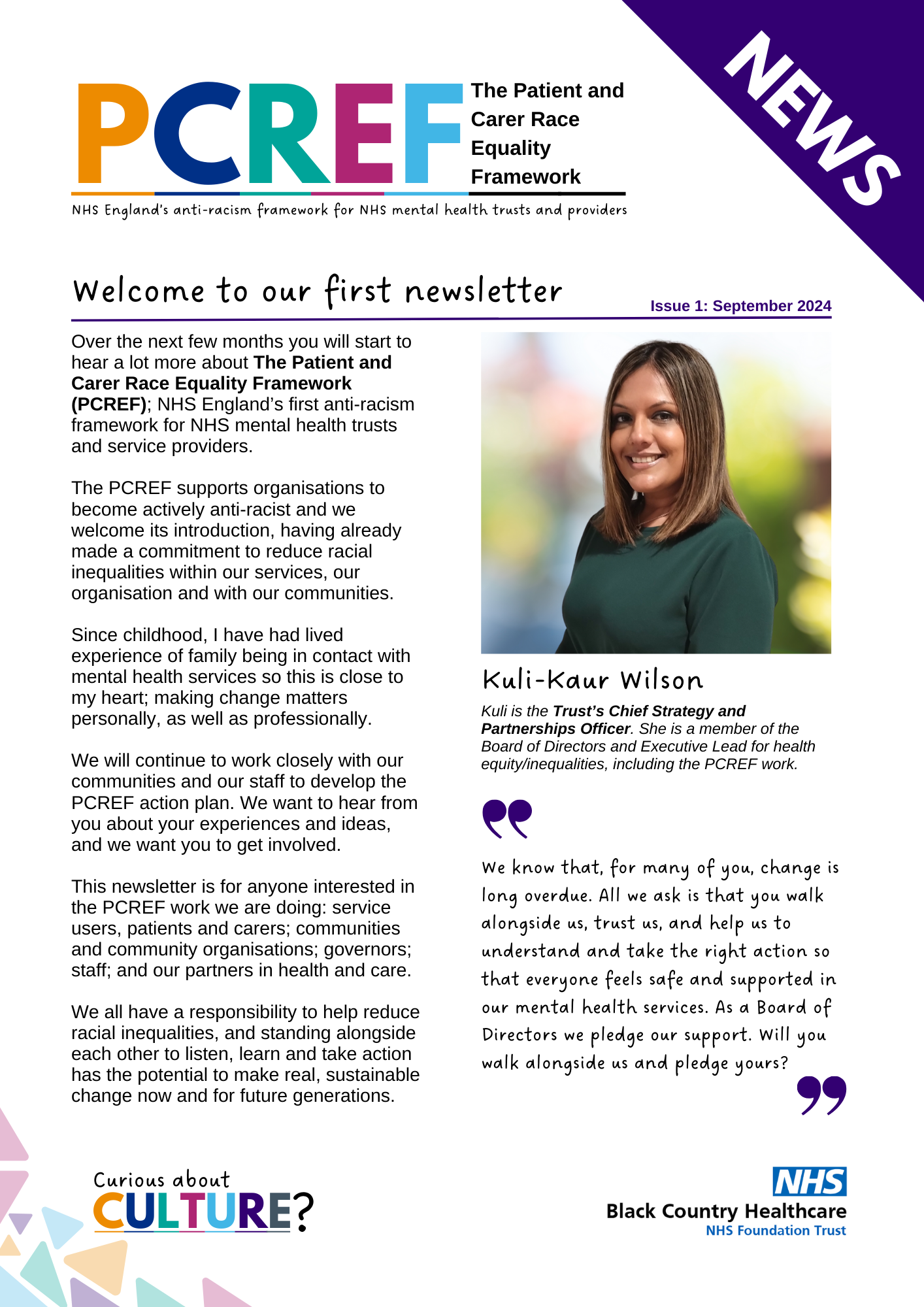

As NHS England's first anti-racism framework, the Patient and Carer Race Equality Framework (PCREF) helps NHS mental health trusts and service providers to improve services for people from diverse ethnic, racial and cultural backgrounds.
The PCREF is a partnership with local services, including the police and local authorities, as well as community and voluntary organisations, patients, service users, carers, families and communities. Our aim is to make sure diverse and minoritised communities are working together to make the PCREF part of standard practice for NHS trusts.
Our PCREF improvement plan was approved by Trust Board in May 2025. You can view the plan, along with reflections from Board and community members below.
We’re really excited to be inviting applications to join a brand-new community group that will help shape the future of mental health services and support across the Black Country.
The PCREF Governance Oversight and Advisory Group will play a vital role in making sure Black Country Healthcare is truly anti-racist, and that the voices and experiences of patients, carers, and communities are at the heart of how services are designed and delivered.
This first phase will run for six months, after which we’ll review and build on what works—together.
What is PCREF?
The Patient and Carer Race Equality Framework (PCREF) is about making sure people from racialised and underserved communities have real influence over how services are run. It brings together young people, adults, and older adults to co-design care and improve outcomes.
Alongside this advisory group, we’ll also be recruiting PCREF Community Ambassadors who will lead local engagement groups and activities, making sure those patients and carers most often left out have a platform. Keep an eye out for applications for this community outreach role in the coming weeks. Together, these two groups will make sure community voices are shaping services at every level.
About the Advisory Group
The group will have eight community representatives (two from each of Sandwell, Dudley, Walsall, and Wolverhampton) plus Black Country Healthcare leads to share data, policies and take recommendations back into the organisation.
What the group will do
As a member, you’ll help provide independent challenge and fresh thinking by:
- Reviewing equality data, audits, and Trust policies every quarter
- Leading or joining smaller subgroups (e.g. inpatient care, mental health in the community, workforce diversity)
- Checking new policies through an equality lens
- Co-chairing projects alongside senior staff
- Sharing recommendations with the wider Health Equity and Anti-Racism oversight board
Time and Support (over six months)
- 2-3 full-day meetings – £250/day
- Up to eight half-day subgroup sessions – £125/half-day
- Training and induction – £250
Total: up to £2,000 per member
Why Get Involved?
By joining, you’ll:
- Help hold Black Country Healthcare to account on its anti-racism commitments
- Shape reports, audits, and activities that directly influence local and regional priorities
- Build lasting partnerships that push forward health equity across the Black Country
How to Apply
If this sounds like something you’d like to be part of, please apply using this online form. The closing date is 30 September 2025. Shortlisted applicants will be invited to an informal conversation.
We’d love for you to bring your voice, expertise, and lived experience to this important work.
For any queries or further information please contact Bchft.pcref@nhs.net
In May 2025, with the support of community members, the draft PCREF improvement plan was approved by Trust Board. Board members heard how the plan had been co-produced with our communities and staff and heard from community leader Jessie Allen. You can read some of the Board members' reflections and read Jessie's reflections below.
We will share regular updates on how we are progressing with the plan.
Black Country Healthcare PCREF improvement plan
Reflections from Board members
Service users from racialised communities (and their families and carers) should feel more involved with the organisation, and see opportunities to work in partnership to develop and review local PCREF plans. They will also feel that their voice is being heard, including with the Trust Board of Directors.
Service users and patients will know that their experience is being listened to as the organisation will regularly look at data and review their feedback to help make continual improvements to services. They will know how to give feedback, and will feel comfortable and confident to do so.
Services will be better tailored to the needs of the community.
The PCREF has three key aspects:
Leadership and governance
Our Trust board will lead on establishing and monitoring plans of action to reduce health inequalities.
Data
New data on improvements in reducing health inequalities will be published, as well as details on ethnicity in all existing data we collect.
Feedback
There will be visible and effective ways for our patients and carers to feedback (and feel comfortable and confident to do so), as well as clear processes to act and report on that feedback.
We recognise that people have different experiences depending on their race and background. We are more open about having conversations about race and inequalities, and will be working hard to come up with solutions to address racism and racial inequality.
We want to encourage our patients, service users, carers, families, community and voluntary organisations, governors and members of the public to get involved with working in partnership to develop the PCREF.
We also want to hear about your experience of ethnicity recording, ethnicity, culture and mental health.
Share your experience and views with the team
You can contact the team by emailing bchft.pcref@nhs.net.
Share your experience and views anonymously
We understand that some people may want to share information, experiences or ideas related to aspects of the PCREF without disclosing who they are. We have provided the anonymous form below.
We will provide general updates in PCREF communications about this feedback, including what we have done with it and why. This will not include any specific information that is shared in the form and will only reference general themes or topics. We will do this so that those colleagues who share anonymous feedback know that we are listening, learning and acting on what they tell us.
Keep up-to-date with our new PCREF newsletter
We will be sharing news about our work to implement the PCREF, in partnership with our communities and staff, in our PCREF newsletter.
PCREF news updates
We shared a PCREF update in our With our communities newsletter in June 2025
The people leading the implementation of the PCREF at the Trust are:
Nageena Bibi, Head of Mental Health Act Legislation
Olivia Horgan, Health Inequalities Strategy and Delivery Manager
The Executive Lead for PCREF is:
Kuli Kaur-Wilson, Chief Strategy and Partnerships Officer
You can contact Nageena, Olivia and Kuli by emailing:
- Read our PCREF leaflet
- PCREF on the NHS England website
- Easy-read version of the PCREF on the NHS England website
A note on language
The PCREF was co-developed with racialised communities, patients and carers. As a first step, it was important to set out the terminology related to the race and cultural identity of people from communities disproportionately impacted when accessing mental health services.
It was important to acknowledge that current legislative terminology used to describe certain race and cultural identity do not always reflect people’s unique intersectional needs and lived experiences.
There is more information on the Centre for Mental Health website, however we are always listening and learning so please get in touch if you have views or resources to share.